The Case for the Mortise and Tenon
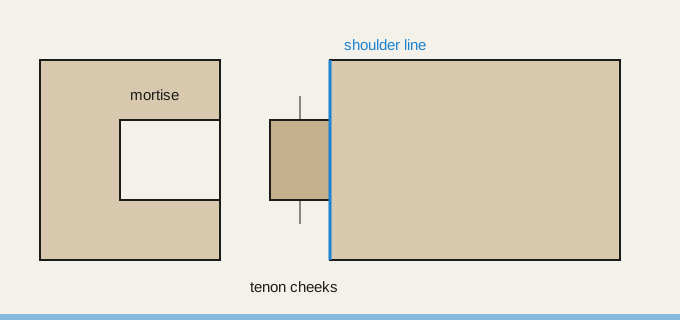
Almost every joint in furniture is a compromise between strength, wood movement and the time it takes to cut. The mortise and tenon has survived because it settles all three at once.
Furniture, timber and the work of the bench

Frames, fits and the cuts that hold a piece of furniture together, from the mortise and tenon to the marking that comes before it.
Almost every joint in furniture is a compromise between strength, wood movement and the time it takes to cut. The mortise and tenon has survived because it settles all three at once.
Most dimensional errors in furniture are not measuring errors. They are errors of transcription, and the story stick removes the transcription entirely.
The bench plane range looks like a catalogue of near-duplicates. It is really three jobs, and three tools will cover them.
Aside
Sharpening treated as an occasional project produces tools that are dull most of the time, because the threshold for starting a project is high and the threshold for carrying on with a slightly dull blade is low. Treated as maintenance, a blade goes back to the stones for a minute at a time, several times a session, and it is never actually blunt. The equipment hardly matters next to the frequency. Whatever is at hand, kept out on the bench rather than put away, will produce sharper tools than a better arrangement kept in a cupboard.
A panel glued from several boards can be flatter and more stable than any single wide board, provided the boards are arranged rather than simply joined.