
Wood Movement, and Why Tabletops Split
Seasoned timber is not finished moving. A board that has sat in a dry room for forty years still takes on moisture in humid weather and gives it up again in dry, and it changes size as it does. Furniture that does not allow for this does not fail immediately. It fails over several seasons, quietly, which is why the cause is so often missed.
The movement is very uneven by direction. Along the length of a board it is negligible, small enough to ignore in furniture. Across the width it is substantial, and across the thickness it is somewhere in between. The practical rule is that a board grows and shrinks across its width and stays the same length, and nearly every movement failure in furniture comes from a construction that did not respect that.
The classic example is a solid tabletop fastened rigidly to a frame or to battens running across its width. The frame does not change length; the top tries to change width. Something must give, and since the fastenings hold, the top splits. It usually splits in dry weather, when the top is shrinking and in tension, rather than in humid weather when it is merely pressing outward.
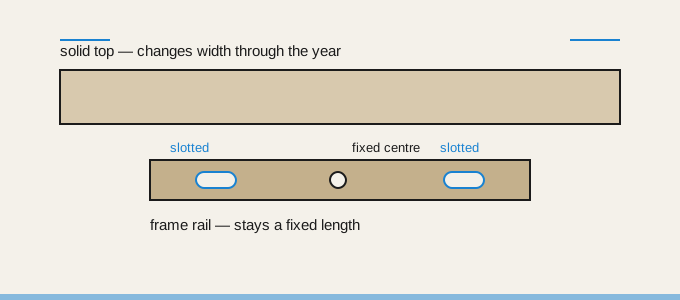
The remedy is to fasten the top so it can slide. Slotted holes running across the width, buttons that sit in a groove, or figure-eight fasteners all do the same job: they hold the top down firmly while letting it move sideways. One fastening near the centre is usually fixed so the top stays registered and moves outward from the middle rather than drifting to one end.
Frame and panel construction solves the same problem differently and is the reason it exists. The panel sits loose in a groove in the surrounding frame, unglued, free to swell and shrink while the frame holds the overall dimension constant. A cabinet door built this way stays the same size all year. The same door built as a solid slab will bind against its opening in one season and show a gap in the other.
There is a corollary worth stating plainly: the amount of movement depends on how the board was cut. Flatsawn stock moves roughly twice as much across its width as quartersawn stock of the same species, so the choice of board and the choice of construction are the same decision made twice.