
Image
Flatsawn, Quartersawn, Riftsawn
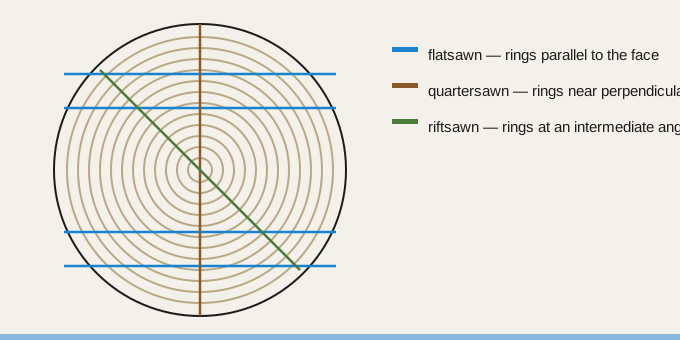
Two boards from the same tree can behave like different materials. The difference is not species or seasoning but where in the round each board was cut, which is read off the end grain as the angle the growth rings make with the face.
When the rings run roughly parallel to the face of the board, at somewhere below thirty degrees, the board is flatsawn. This is how most timber is cut, because it is the fastest way through a log and wastes the least. Flatsawn boards show the familiar cathedral figure, those nested arches on the face, and they are the cheapest way to buy a given species. They also move the most across their width, and they cup, because the rings are trying to straighten as they dry.
When the rings cross the face at close to a right angle, the board is quartersawn. The face shows straight parallel lines rather than arches, and in oak it also shows ray fleck, the pale ribbon-like flecks running across the grain, which is the medullary ray exposed in section. Quartersawn stock moves roughly half as much across its width as flatsawn stock of the same species, and it does not cup, because there is no ring curvature across the width to straighten out.
Riftsawn sits between the two, with rings crossing at roughly thirty to sixty degrees. It gives the straightest, quietest face of all, with no cathedral arches and no ray fleck, and it is the usual choice for table and chair legs because all four faces of a square leg then look the same. It is also the most wasteful to produce, which is why it costs the most.
The practical consequence is that the cut should be chosen for the job rather than by price. A wide tabletop that must stay flat wants quartersawn or riftsawn boards, or at minimum flatsawn boards alternated so their cupping opposes. Drawer sides want quartersawn stock so the drawer keeps fitting in humid weather. A door panel floating in a groove can be flatsawn, because the whole point of floating it is that the panel is permitted to move.
Reading this off a board takes a moment at the end grain and saves a great deal of work later. A stack of timber is not one material at a uniform price; it is a range of behaviours, and the end of each board announces which one you are buying.