
The Case for the Mortise and Tenon
Almost every joint in furniture is a compromise between three things: how much load it will carry, how it behaves when the wood around it swells and shrinks, and how long it takes to cut. Most joints settle one of those well and the other two badly. The mortise and tenon settles all three, which is why it has outlived nearly every attempt to replace it.
The strength comes from geometry rather than from adhesive. A tenon is a tongue cut on the end of one piece; a mortise is the matching rectangular hole cut into the face of another. When the tenon goes home, the shoulders around it bear against the face of the mortised piece, and that shoulder contact is what stops the joint racking. A chair that wobbles is almost never a chair whose glue failed. It is a chair whose shoulders never touched properly in the first place.
The glue surface matters too, but not in the way people expect. The two cheeks of the tenon are long grain meeting long grain, and that is the only glue joint in woodworking that is reliably stronger than the wood itself. The ends of the tenon meet end grain, which glues poorly and can be ignored. So the cheeks do the holding and the shoulders do the bracing, and a joint cut with that division of labour in mind is a good deal easier to cut well.
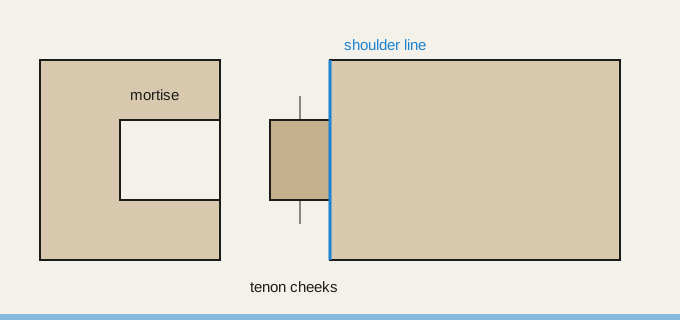
Wood movement is the third part. A rail joined into a leg will expand and contract across its width through the year while the leg does the same. Because both pieces move in the same direction across the joint, the mortise and tenon moves with itself rather than against itself. Compare that with a wide board screwed flat to a frame, which tears itself apart within a few seasons. The joint is not merely strong; it is strong in a way that survives the wood staying alive.
There is a proportion worth remembering. The tenon should be roughly a third of the thickness of the stock, which puts it in the middle of the rail and leaves equal walls of material either side of the mortise. Thicker than that and the mortise walls grow thin and split when the tenon is driven. Thinner and the tenon itself becomes the weak point. A third is not a magic number so much as the place where neither part is obviously sacrificed.
Cut the mortise first and fit the tenon to it. A mortise is difficult to adjust once it exists, whereas a tenon can be pared down by shavings until it slides in with firm hand pressure and no hammer. That order of operations removes most of the frustration from the joint, and it is the single change that turns a joint people avoid into one they cut without thinking about it.